
Finding government contract opportunities shouldn’t begin the day an RFP appears on SAM.gov.
Yet that’s exactly how many companies approach federal contracting.
Someone finds a solicitation that looks promising. The work fits the company’s capabilities. The NAICS code makes sense. The contract appears to be the right size.
The RFP gets passed around internally.
Business development takes a look. Operations confirms the company can perform the work. Someone starts reviewing the requirements. Pricing gets involved.
Then comes the decision:
Let’s go after it.
There’s nothing wrong with finding an RFP and deciding to compete.
The problem is assuming that’s where the opportunity began.
It probably didn’t.
The federal agency may have been working toward that procurement for months. And some of the companies you’ll be competing against may have been watching it for just as long.
Government Contract Opportunities Don’t Suddenly Appear
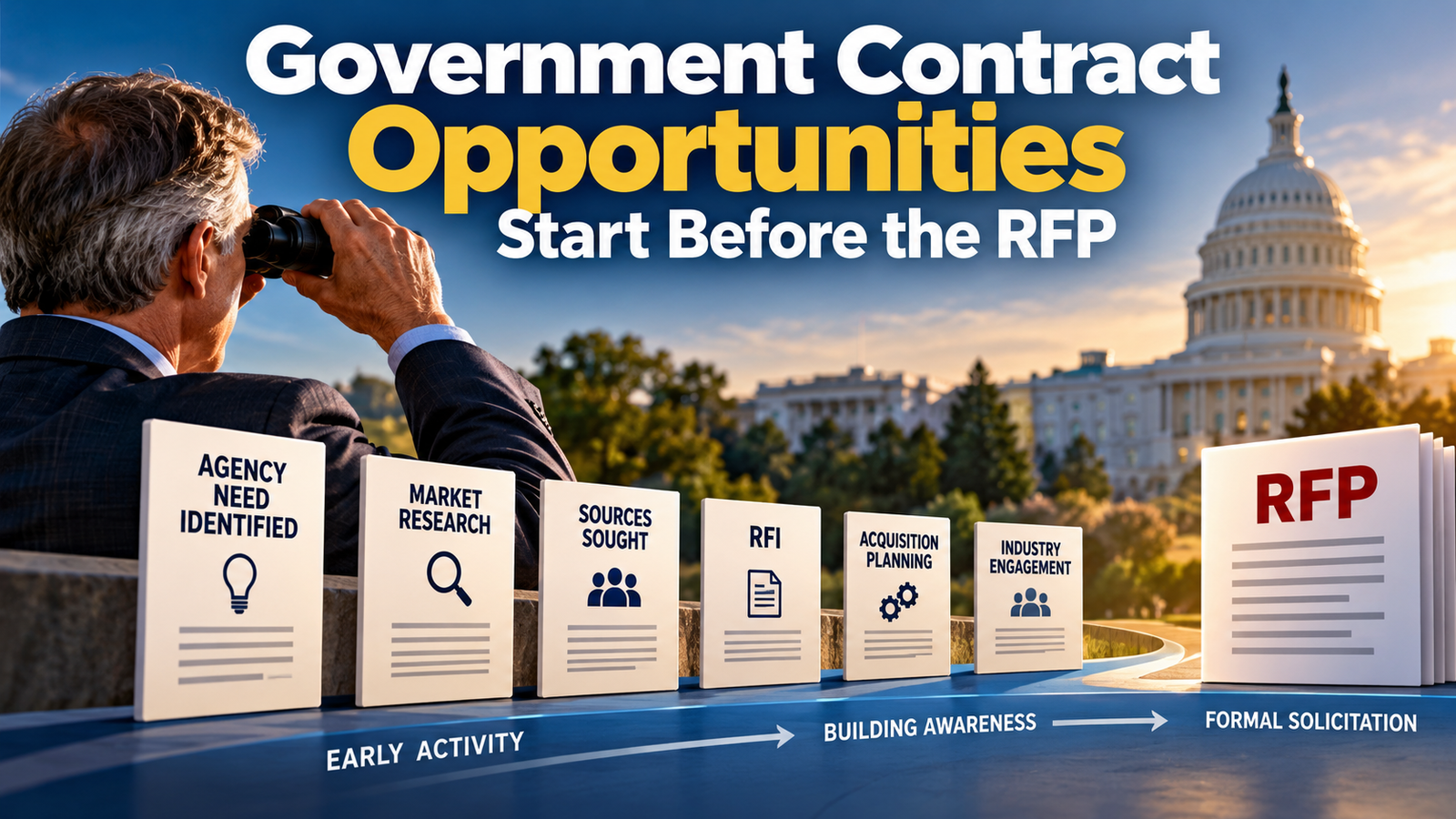
Think about what has to happen before an agency releases a solicitation.
Someone has identified a need.
Maybe an existing contract is approaching expiration. A program could be changing. Technology may need to be replaced. A service needs to continue. A new requirement has emerged.
Whatever the reason, the government usually has work to do before asking companies for proposals.
The agency may conduct market research.
It may consider different acquisition approaches.
Funding has to be addressed.
Requirements have to be developed.
There may be a Sources Sought notice or Request for Information.
The agency may seek input from industry.
All of this can happen before the RFP you’re looking at ever appears.
So while you’re seeing a new opportunity, you’re not necessarily seeing the beginning of it.
You’re seeing the point where the government is ready to ask for formal responses.
That’s a big difference.
If You’re Only Watching RFPs, You’re Starting Late
I’ve seen businesses approach federal contracting almost entirely through solicitations.
They search for government contract opportunities.
They find an RFP.
They read the requirements.
They decide whether they can perform the work.
Then they start writing.
That can work.
But if searching for open solicitations is your entire business-development strategy, you’re limiting what you can learn before the competition formally begins.
It’s a little like finding a house you want after several other buyers have already been through it.
You can still make an offer.
But wouldn’t you rather have known the house was coming onto the market?
Government contracting isn’t exactly the same, of course, but the point holds.
Earlier awareness gives you more time to understand what you’re getting into.
Look for Tomorrow’s Government Contract Opportunities
Instead of spending all your time looking at solicitations that are open today, start watching for signs of what may be coming next.
Ask some different questions.
What federal agencies regularly buy what your company provides?
What contracts do those agencies already have in place?
When might those contracts expire?
Who currently performs the work?
Has the agency released a Sources Sought notice?
Has there been an RFI?
Does the requirement appear in an acquisition forecast?
Has the agency held or announced an industry day?
Does the procurement appear likely to be a small-business set-aside?
Now you’re doing more than searching for something to bid on.
You’re beginning to understand the market you’re trying to enter.
And that can change the way you approach government contract opportunities when they eventually become formal solicitations.
Don’t Ignore Sources Sought Notices
A Sources Sought notice doesn’t have the excitement of an RFP.
There’s no contract to win that day.
There’s no proposal that will lead directly to an award.
Because of that, some businesses pass right over them and keep searching for active solicitations.
That can mean missing useful information.
A Sources Sought notice can be part of an agency’s market research. The government may be trying to determine what businesses are capable of meeting a particular requirement.
In some cases, the agency may also be trying to determine whether capable small businesses exist in the marketplace.
If the requirement fits your company, pay attention.
Read what the agency is asking.
If responding makes business sense, explain your capabilities clearly. Show relevant experience. Answer what was asked instead of simply attaching a generic capability statement and hoping someone connects the dots.
Responding doesn’t guarantee anything.
It doesn’t give you special treatment if a solicitation is eventually released.
But it does put you in a much different position than discovering the requirement for the first time months later.
An RFI Can Tell You What the Government Is Thinking About
Requests for Information deserve attention for many of the same reasons.
An agency may be looking for technical information.
It may want to better understand available products or services.
It may be asking industry whether its proposed approach is realistic.
Sometimes the questions themselves tell you quite a bit.
What is the agency concerned about?
Where does it need more information?
What capabilities is it trying to understand?
What challenges might it be anticipating?
You don’t need to respond to every RFI.
You shouldn’t.
But if the agency is one you want to work with and the requirement fits what your company does, an RFI can give you an early look at a potential opportunity.
That’s useful information long before proposal writing begins.
Watch Existing Contracts Too
Here’s another place companies can look for future government contract opportunities:
Contracts the government has already awarded.
Suppose a federal agency already buys the service your company provides.
Someone may already be performing that work.
That doesn’t mean there’s nothing for you to do.
It means you have homework.
When was the contract awarded?
How long is the period of performance?
Are there option years?
Who is the incumbent contractor?
What was the approximate value when it was awarded?
Does the requirement appear likely to continue?
You’re not looking for confidential information.
You’re trying to understand a marketplace using information legitimately available to businesses.
Think about the difference that can make.
One company discovers the opportunity when the RFP appears.
Another company has been watching the requirement, learning about the agency and understanding the existing contract for months.
Both may ultimately compete for the same work.
But they didn’t necessarily arrive at the starting line with the same amount of information.
Know the Agency Before You Need Something From It
This is also where the people side of government contracting matters.
Building relationships with federal agencies doesn’t mean trying to get inside information.
It doesn’t mean trying to influence a procurement improperly.
And it certainly doesn’t mean calling a contracting officer every few weeks asking whether there’s anything you can bid on.
It means understanding the organizations you hope to serve.
Who buys what you sell?
What is their mission?
What problems are they trying to solve?
Where does your company genuinely fit?
Does the agency have a small-business office?
Are there outreach events?
Does it publish an acquisition forecast?
Are there appropriate industry events where businesses can learn about future requirements?
A good relationship begins with understanding the customer.
That’s true in the private sector.
It’s also true in government contracting.
SAM.gov Is a Tool, Not a Business-Development Strategy
SAM.gov Contract Opportunities is an important resource for finding government contract opportunities, including pre-solicitation notices, solicitations, award notices, and sole-source notices.
But don’t treat it like a shopping catalog.
You’re not browsing through contracts until you find one you like and putting it into your cart.
When you find an RFP, you’re entering a competition.
Other businesses may know the agency better than you.
They may understand the requirement better.
Some may have performed similar work for that customer.
One may be the incumbent contractor.
Others may have been following the potential procurement long before the final solicitation appeared.
That’s why saying “We can do this work” isn’t enough.
Several companies may be able to do the work.
Your challenge is demonstrating why the government should have confidence in your company’s approach to doing it.
Start Earlier and Narrow Your Focus
Starting earlier does not mean pursuing everything you find. A disciplined GovCon strategy also means recognizing that bidding on every RFP is not profitable.
Small businesses that need help researching the federal marketplace can also use SBA-supported APEX Accelerators, which provide government contracting assistance and can help businesses research past contract opportunities.
This does not mean spending every day trying to predict hundreds of future procurements.
That would defeat the purpose.
Start smaller.
Identify a manageable group of agencies that buy what your company actually provides.
Learn how those agencies purchase those products or services.
Look at previous awards.
Watch contracts that may be approaching the end of their performance periods.
Review acquisition forecasts.
Pay attention to Sources Sought notices and RFIs.
Participate in appropriate industry outreach.
Understand who the incumbent contractors are.
And learn something about the mission behind the requirement.
That work isn’t as exciting as finding an RFP with a deadline attached to it.
But it can put you in a much stronger position when that RFP finally arrives.
The RFP Shouldn’t Be Your Starting Gun
There will always be government contract opportunities you discover for the first time when a solicitation is released.
Some of them may absolutely be worth pursuing.
But if every opportunity begins with someone in your company saying:
“Hey, look what I just found on SAM.gov.”
You may want to rethink your approach.
Instead of asking only:
What can we bid on today?
Start asking:
What might our target agencies need six months or a year from now—and what can we learn about those requirements today?
That’s a different way of looking at government contract opportunities.
You’re no longer waiting for an RFP to tell you where the market is going.
You’re paying attention before it gets there.
And when the solicitation finally arrives, your team may discover that some of the most valuable work was done long before anyone started writing the proposal.