
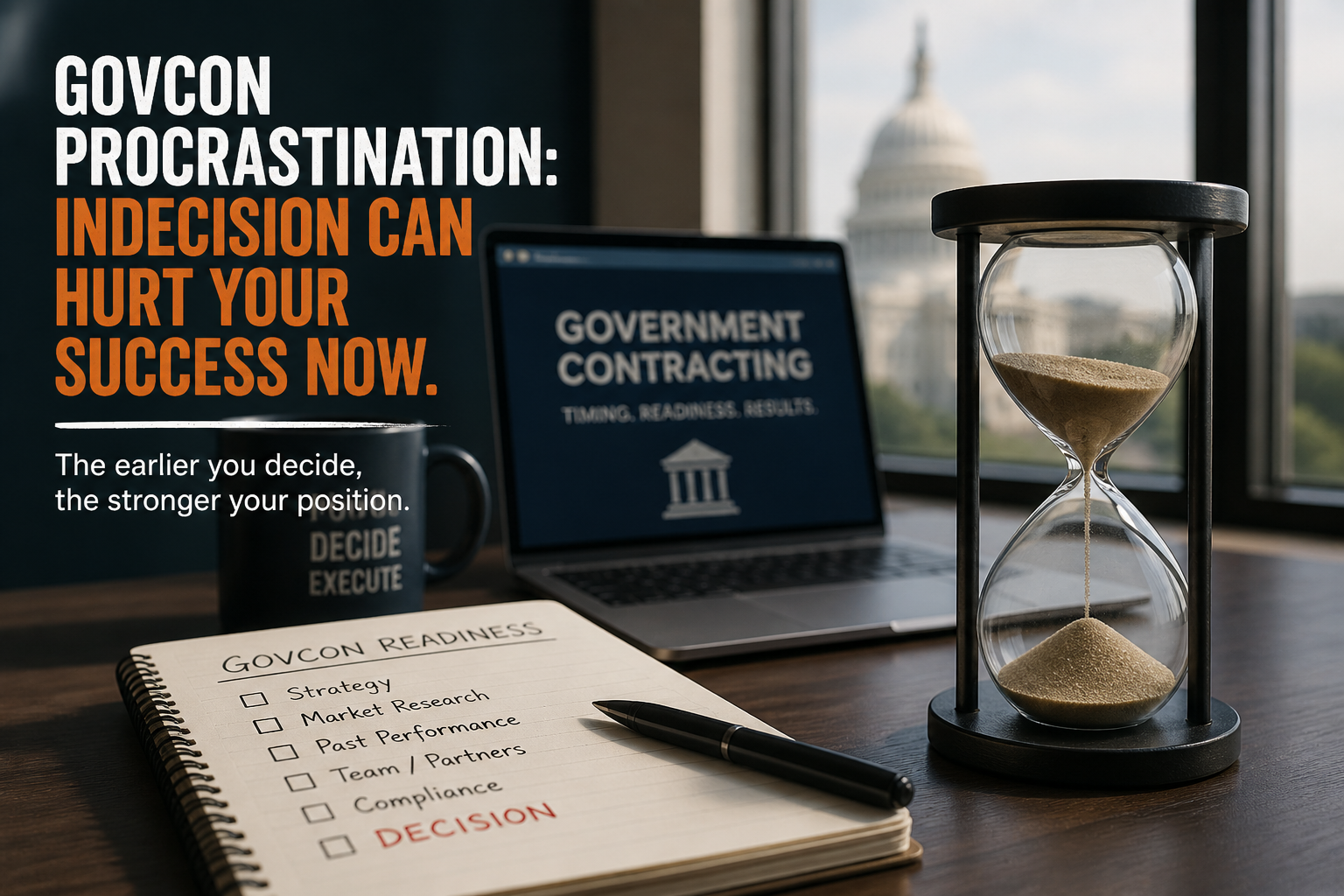
GovCon Procrastination does not always look like doing nothing. Sometimes it looks like researching, watching, waiting, discussing, reconsidering, and telling yourself the timing is not quite right yet. On the surface, that can feel responsible. No one wants to rush into government contracting without understanding the landscape. But there is a point where careful evaluation turns into delay, and that delay can quietly weaken a company’s chances before it ever submits a proposal.
I have seen this pattern show up in different forms over the years. A company knows it wants to explore government work, but it hesitates to define where it fits. Leadership talks about federal opportunities, but no one owns the next step. The team gets registered, looks at SAM.gov once in a while, and waits for something obvious to appear. Months pass, and when a solicitation finally catches their attention, the response is no longer strategic. It becomes rushed, reactive, and shaped by whatever time is left.
Why GovCon Procrastination Creates Risk
The problem with GovCon Procrastination is that government opportunities do not wait for a company to feel fully comfortable. Requirements often begin taking shape long before an RFP is released. Agencies may issue RFIs, sources sought notices, draft documents, industry day announcements, or other signals that give the market a chance to pay attention and respond. Companies that wait until the final solicitation appears may technically still have a chance to bid, but they are often entering the conversation after important thinking has already happened.
That late entry creates pressure. Instead of asking whether the opportunity truly fits, the company starts asking whether it can pull together a response in time. Instead of evaluating staffing, past performance, pricing, compliance, and execution risk with a clear head, the team starts moving fast because the clock is running. That is where weak bid decisions happen. It is not always because the company lacks capability. Sometimes it is because the company delayed the more difficult readiness questions until the opportunity was already moving on without them.
Indecision Can Look Like Preparation
One of the tricky parts of GovCon Procrastination is that it can disguise itself as preparation. A business owner may spend time reading articles, attending webinars, downloading guides, and listening to advice from people who have been around the federal space. None of that is bad. In fact, it can be useful. But learning without action has a shelf life. At some point, the company has to decide where it belongs, what it can realistically perform, and which opportunities are worth pursuing.
That does not mean every company should jump in to bid. In many cases, the right answer may be to pause, narrow the focus, build past performance in a different way, strengthen internal processes, or avoid certain opportunities altogether. But those are still decisions. They are different from drifting. A clear “not yet” based on honest readiness is much stronger than a vague “maybe later” that keeps everyone busy but moves nothing forward.
The Cost of Waiting Too Long
The cost of waiting is not always obvious at first. A company may not feel any pain while it is still “thinking about” government contracting. The real cost appears later, when an opportunity seems close enough to chase but the groundwork has not been done. The company may lack a clear target agency, a realistic capability statement, a defined teaming strategy, or a firm understanding of what performance would actually require. By then, the issue is no longer just whether the proposal can be written. The issue is whether the company should be pursuing the work at all.
This is where government contracting can become expensive even before a contract is awarded. Time goes into meetings, research, proposal support, pricing, documentation, and internal coordination. People get pulled away from other work. Outside help may be brought in late. The company may still submit a proposal, but the process feels strained because too many important questions were left unresolved until the pressure was already high.
Moving From GovCon Procrastination to Better Decisions
The better approach is not to panic. It is discipline. Companies do not need to chase every opportunity, nor do they need to treat every federal notice as a once-in-a-lifetime event. What they do need is a practical way to decide earlier. That means looking at fit before excitement takes over, understanding the agency environment before the RFP drops, and being honest about whether the company can perform the work without creating unnecessary risk.
GovCon Procrastination loses its grip when a company replaces vague interest with specific decisions. Which agencies make sense? Which NAICS codes actually fit the work? What past performance can be shown? What partners might be needed? Is the contract size realistic? What would successful performance require after the award? These questions are not glamorous, but they matter. They keep a company from confusing movement with progress.
Final Thought on GovCon Procrastination
GovCon Procrastination is not always caused by laziness. More often, it comes from uncertainty, caution, competing priorities, or the hope that the right opportunity will make the path obvious. Unfortunately, government contracting rarely works that neatly. By the time something looks obvious, other companies may already understand the requirement, the agency, the risks, and the likely path forward.
The companies that improve their odds are not always the biggest or the loudest. They are often the ones who make clearer decisions earlier. They know when to engage, when to prepare, when to pass, and when to pursue. That kind of discipline does not guarantee success, but it does reduce wasted effort. And in GovCon, reducing wasted effort is not a small thing.