
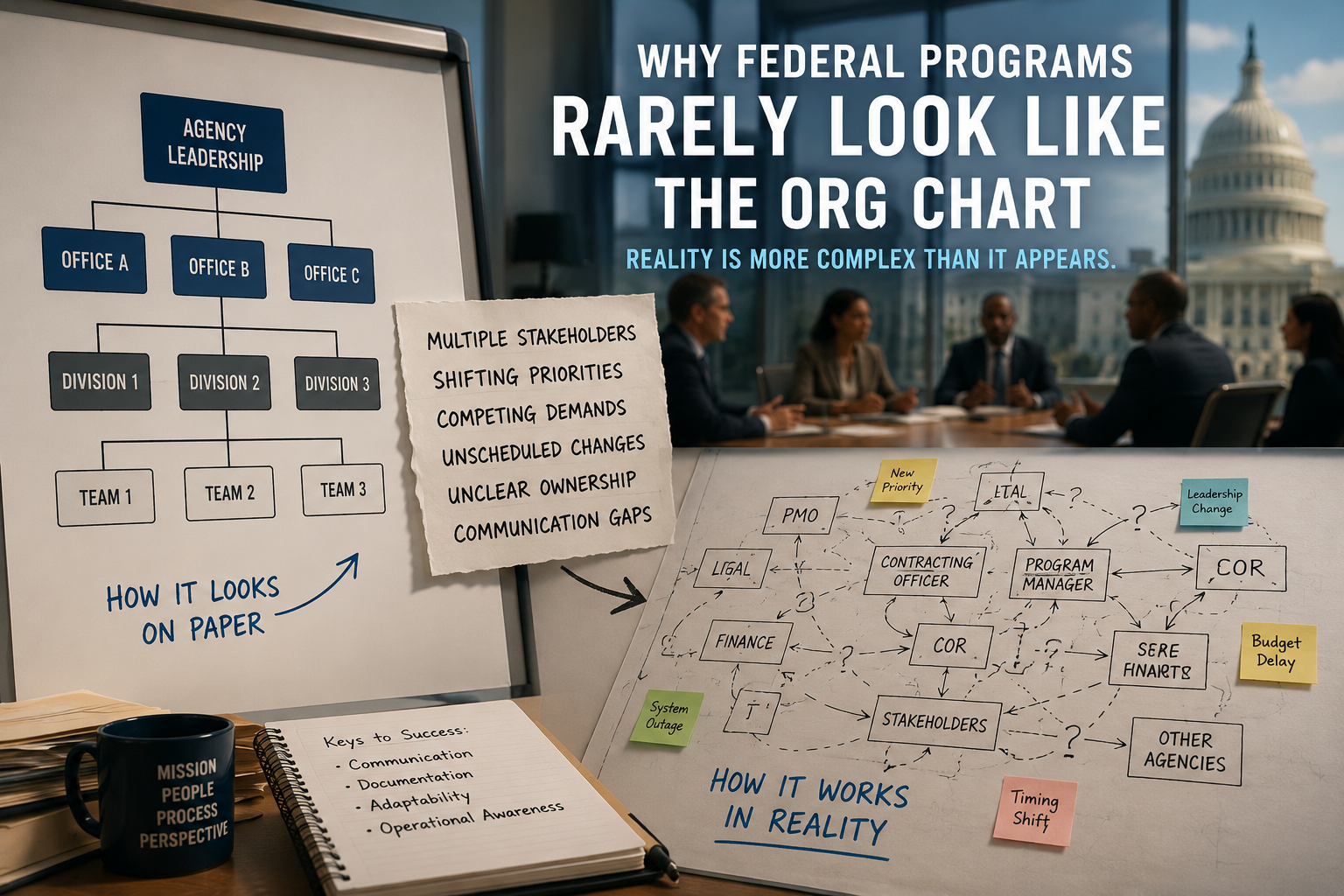
One of the biggest misunderstandings many companies have about working with the federal government is assuming that programs operate the way they appear on paper.
From the outside, government environments often look highly structured. There are offices, divisions, reporting chains, acquisition teams, program managers, contracting officers, technical representatives, and organizational charts that appear to define ownership. To someone new to federal contracting, it can seem like a very orderly system where responsibilities are clearly separated, and decisions move in predictable ways.
In reality, most large federal environments are far more dynamic than that.
Over the years, I spent much of my career working within government operations, where programs depended on coordination among multiple offices, technical teams, leadership layers, support organizations, and operational groups that did not always report through the same chain of command. On paper, responsibilities might have appeared straightforward. In practice, however, priorities shifted, operational pressures competed for attention, and decisions were often influenced by factors that were never fully visible from the outside.
That complexity is not necessarily a sign that something is broken. Large organizations naturally evolve layers of oversight, communication, risk management, and operational dependency over time. Federal agencies are no different. In many cases, they are managing missions that affect public services, healthcare, national security, infrastructure, benefits delivery, or long-term operational continuity. The environment surrounding the contract is often just as important as the contract itself.
What many companies discover too late is that success in government contracting is not simply about satisfying the written requirements of a solicitation. It also involves understanding the operational environment the work is entering. That environment may include competing internal priorities, leadership transitions, budget timing issues, coordination challenges between offices, staffing limitations, security requirements, documentation expectations, and varying interpretations of urgency among different stakeholders.
This is one reason why some programs that look straightforward during the procurement phase become significantly more complicated once work begins.
A contractor may assume that one office has final authority over decisions, only to discover that several groups influence execution in different ways. Communication that seemed clear during early meetings may become more fragmented as operational realities change. Timelines that appeared firm may shift because another dependency inside the agency changed direction or experienced delays. None of this is unusual inside large environments, but companies that enter government contracting expecting a perfectly linear process are often surprised by how much coordination and adaptability are required.
I think this is also why experienced government personnel tend to place such a high value on communication, documentation, continuity, and operational awareness. Those things are not just administrative preferences. They are often the mechanisms that keep large programs functioning when priorities shift or pressure increases.
From the outside, it is easy to focus primarily on the visible parts of government contracting: solicitations, proposal submissions, awards, and contract values. Those are important, of course. But much of the real operational reality exists underneath the surface in the day-to-day coordination that keeps programs moving forward.
That perspective changes how you evaluate opportunities.
It changes how you think about readiness, staffing, communication structures, escalation paths, and execution risk. It also changes how you interpret delays, ambiguity, or shifting priorities once work begins. Companies that understand those realities early usually adapt more effectively because they recognize that federal environments are rarely as simple as the org chart suggests.
Over time, I came to appreciate that some of the most successful programs were not necessarily the ones with the cleanest presentations or the most polished language. They were often the ones where teams communicated consistently, documented decisions carefully, adapted to operational realities without panic, and maintained continuity even when conditions changed around them.
That kind of operational stability rarely receives much attention from the outside, but inside government environments, it matters every day.