
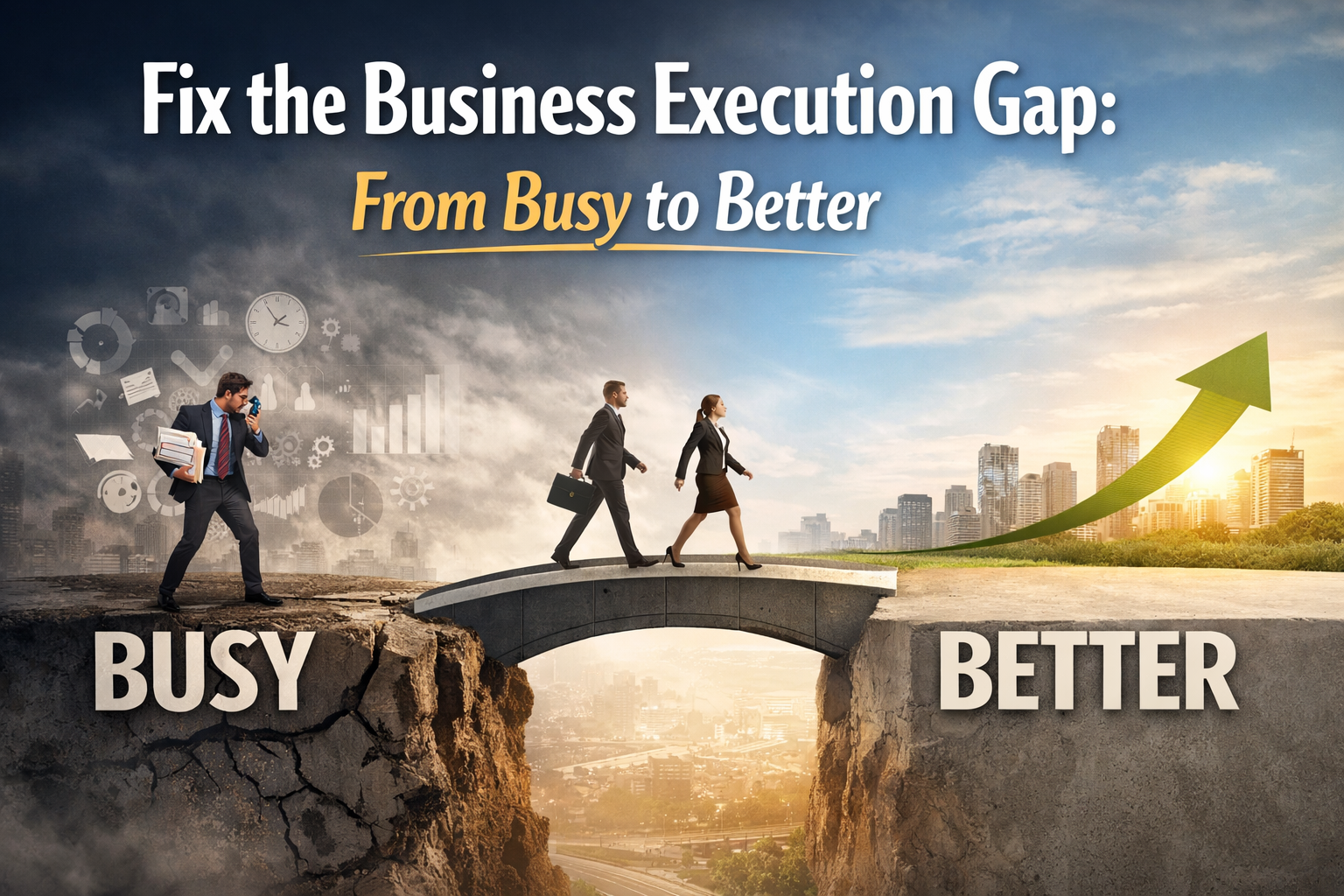
There’s a point in business where effort stops lining up with results, and it doesn’t happen all at once. You’re still working, still making decisions, still moving things forward, but when you step back and look at it honestly, growth isn’t showing up the way it should. This is where the business execution gap begins to take shape, even if you don’t recognize it right away.
Most businesses don’t slow down because they stop working. They slow down because the work they’re doing no longer connects in a way that produces meaningful outcomes. Everything looks active on the surface, but underneath, the pieces aren’t building on each other.
Understanding the Business Execution Gap
The business execution gap is the difference between effort and outcome. It’s the space where activity exists, but results remain inconsistent, unpredictable, or flat. It doesn’t come from a lack of knowledge, because information is everywhere now, and it doesn’t come from a lack of effort, because most business owners are putting in more time than ever.
It comes from how that effort is applied. When actions are scattered, constantly changing, or disconnected from a clear direction, the result is movement without momentum. Things get done, but nothing compounds. Without that compounding effect, progress never really takes hold.
Why Being Busy Feels Like Progress
Being busy creates the illusion that things are working, because activity feels like forward motion. You’re answering emails, creating content, adjusting your site, exploring new ideas, and trying to stay on top of everything. Each of those actions feels productive in the moment, and in isolation, they often are.
The problem shows up when those actions don’t connect. Without consistency and alignment, they remain isolated efforts instead of part of a larger system. It’s like pushing something forward a few steps, stopping, changing direction, and starting again. You’re putting in the effort, but you’re not gaining real ground.
This is where the business execution gap quietly widens: the business is active but not aligned.
What’s Driving the Business Execution Gap Right Now
The current environment is making the business execution gap more visible than ever. With artificial intelligence, automation tools, and online platforms, it’s easier than ever to start and run a business. The barrier to entry is low, and the ability to act quickly has increased.
But speed without direction creates its own problem. When everything is available, it becomes easier to chase multiple ideas at once. Strategies get replaced before they have time to work, and attention shifts without a clear reason. The result is a constant cycle of starting and restarting, which prevents anything from building long enough to produce results.
The business execution gap isn’t growing because people are doing too little. It’s growing because they’re doing too much without a clear structure guiding those efforts.
Fix the Business Execution Gap by Narrowing the Focus
Closing the business execution gap doesn’t require doing more. In most cases, it requires doing less, but doing it with intention. The first step is identifying what actually drives results in your business, not what feels productive, but what consistently moves things forward.
Once those actions are clear, the focus shifts to repetition and refinement. Instead of constantly introducing new ideas, the goal becomes improving what is already in place. This is where momentum begins to build, because consistency allows small improvements to compound over time.
That’s the part most businesses never stay with long enough to see.
From Busy to Better
Moving from busy to better is not about increasing effort. It’s about connecting effort to outcome in a way that produces steady progress. That means creating structure, staying focused, and allowing strategies to develop before replacing them. It also means accepting that progress often looks slower at the beginning, even when it’s moving in the right direction.
Businesses that close the business execution gap are not necessarily the most innovative or aggressive. They are the ones that stay aligned long enough for their efforts to take hold and build into something meaningful.
Final Thought
The business execution gap is not a failure point. It’s a signal that effort and direction are out of sync. Recognizing the signal allows you to adjust before too much time is lost chasing the wrong things.
Once that alignment starts to take shape, the path forward becomes clearer. Not easier, but more focused. Not faster, but more effective. And over time, that shift is what turns effort into results.
Next Step
Take a step back and look at what you’re doing today. Identify the few actions that actually move your business forward and commit to them with consistency. When those actions start to build on each other, the business execution gap begins to close, and that’s when busy finally starts to turn into better.