
If you follow federal small business contracting news, the past few weeks have produced several developments aimed at strengthening small-business participation.
The government is tightening oversight of the 8(a) Business Development Program, emphasizing competition over sole-source awards, and encouraging greater participation by veteran-owned businesses.
On paper, those changes make sense. They aim to protect taxpayers, strengthen integrity in the procurement system, and ensure small businesses benefit from programs designed to help them.
But after more than three decades working inside federal operations, I’ve seen how policy goals collide with operational reality.
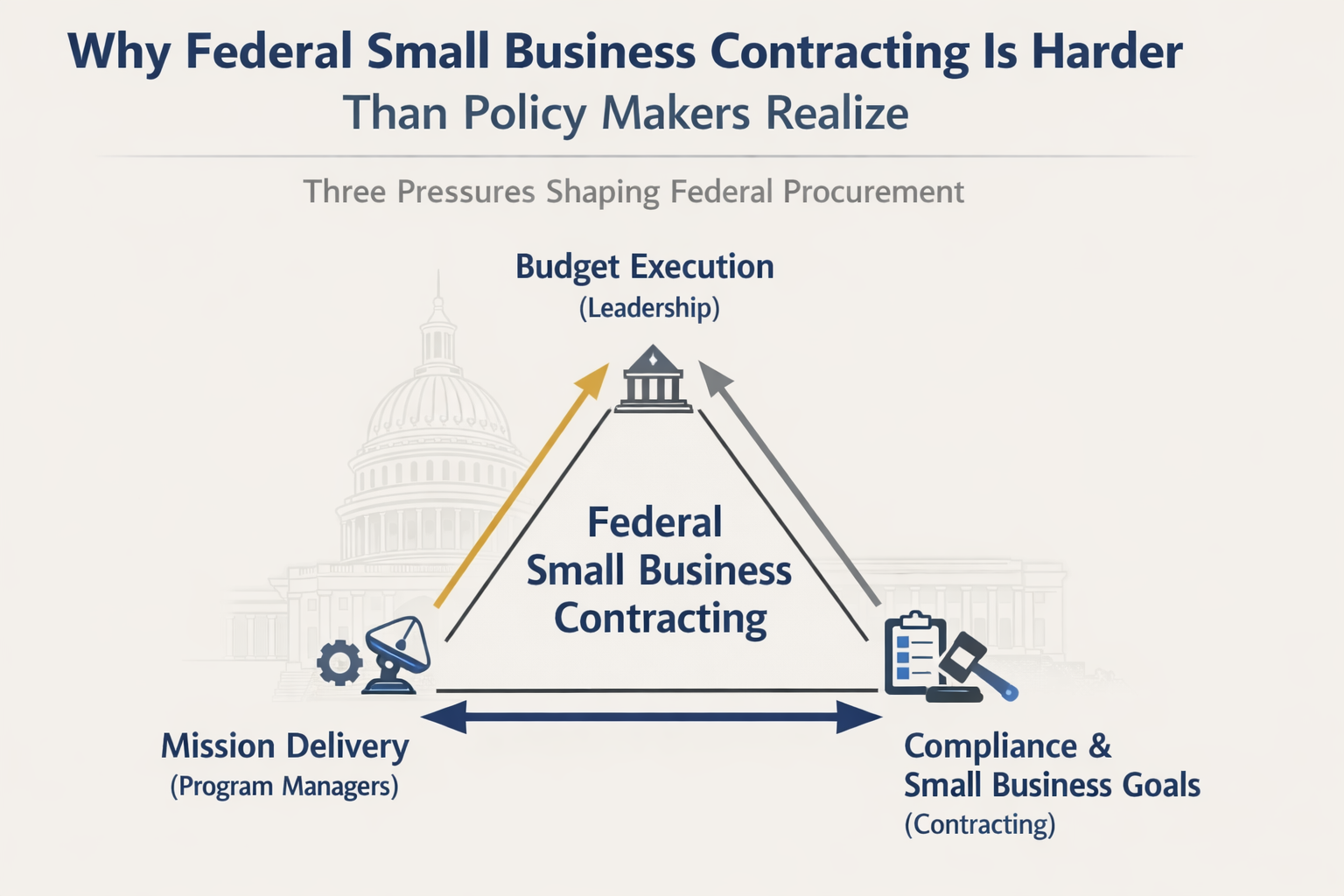
Federal contracting doesn’t operate in a straight line. It operates within a system where several pressures act in different directions simultaneously.
Understanding those pressures helps explain why meeting small-business contracting goals is often far more complicated than it appears from the outside.
Three Signals Coming From Washington
Recent announcements highlight where federal policy appears to be heading.
First, enforcement actions targeting firms in the 8(a) Business Development Program suggest the government intends to tighten oversight and reduce potential abuse of sole-source awards.
Second, new guidance from the U.S. Department of the Treasury emphasizes verifying that small-business primes are actually performing the work on set-aside contracts.
Third, updated scorecard metrics from the U.S. Small Business Administration appear to place greater emphasis on competition and increased participation by veteran-owned small businesses.
Taken together, these signals point toward stronger compliance expectations and greater accountability across federal agencies.
But implementing those expectations inside agencies is not always straightforward.
That’s because federal contracting decisions are shaped by three different pressures that exist at the same time.
The Three Pressures Inside Federal Agencies
Pressure #1: Budget Execution
Senior leadership is responsible for ensuring program funds are executed.
Federal budgets operate on timelines. If funding is not obligated within certain periods, agencies risk losing access to those resources in future cycles. When that happens, programs can lose momentum, and long-term planning becomes more difficult.
As a result, leadership often focuses on keeping programs moving and ensuring dollars are used effectively before deadlines arrive.
That pressure alone can shape procurement timelines and priorities.
Pressure #2: Mission Continuity
Program managers live in a different reality.
Their responsibility is delivering mission outcomes — keeping systems running, deploying new technology, maintaining operational capability, and supporting the public services their agencies provide.
Those responsibilities often expand faster than staffing levels.
In many agencies, new systems, tools, and program requirements are layered onto teams that were already operating near capacity. That means managers are constantly balancing operational needs with administrative processes.
When a procurement slows down, the immediate concern is rarely policy compliance.
The concern is whether the mission can continue without interruption.
Pressure #3: Procurement Compliance
Contracting officers operate under a different set of responsibilities.
They must ensure that procurements comply with federal regulations, support competition requirements, and meet small-business participation goals established by the U.S. Small Business Administration.
They also carry the burden of documentation, audit readiness, and protest risk.
Every procurement decision must stand up to scrutiny — sometimes years after the contract is awarded.
That makes caution and compliance essential parts of the process.ce.
When These Forces Collide
Individually, each of these pressures makes sense.
Senior leaders must manage budgets responsibly.
Program managers must deliver mission outcomes.
Contracting officers must protect the integrity of the procurement process.
But those priorities do not always move in the same direction.
Leadership may push for faster execution of funds.
Program teams may need the capability quickly to keep operations moving.
Contracting officers must ensure the process meets regulatory requirements and small-business participation goals.
Layer in new oversight initiatives, evolving policy priorities, and an acquisition workforce that has been stretched thin for years, and the system becomes increasingly complex.
That complexity is where small-business contracting goals often become difficult to implement exactly as policymakers envision them.
Understanding the Environment
None of this diminishes the importance of small-business participation in federal contracting. Those programs remain an essential pathway for companies entering the federal marketplace.
But it does highlight something many companies overlook.
Success in federal contracting isn’t just about identifying opportunities.
It’s about understanding the environment in which those opportunities are created.
Because federal procurement decisions rarely arise from a single requirement or rule.
They emerge from the interaction among mission needs, policy goals, regulatory requirements, and budget pressures — all operating simultaneously.